
Transitional Justice and the Humanitarian–Development–Peace Nexus in Syria
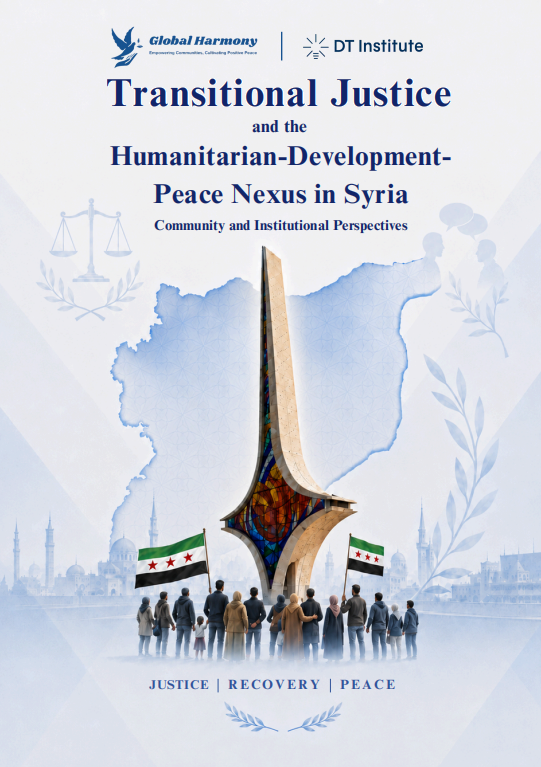
Transitional Justice and the Humanitarian–Development–Peace Nexus in Syria: Perspectives from Communities and Institutions
As Syria moves through a critical period of political transition, the question is no longer whether transitional justice should be pursued, but how it can become part of the country’s broader recovery and peacebuilding process.
This new policy brief by Global Harmony Foundation, in partnership with DT Institute, examines how transitional justice can be meaningfully integrated into humanitarian and development programming in Syria. Drawing on consultations with affected communities and Syrian institutional and civil society actors, the brief highlights a fundamental message: recovery cannot be separated from justice.
For victims and their families, access to health care, livelihoods, education, housing, psychosocial support, reconstruction and assistance in resolving issues related to the forcibly disappeared are not simply development needs. They can also represent recognition, dignity and elements of reparative justice.
As Syria advances its transitional justice process and considers the development of a national legal framework, the brief offers practical recommendations for Syrian government institutions, transitional justice bodies, national and international NGOs, UN agencies and donors. It calls for stronger coordination between humanitarian, development and transitional justice actors, meaningful participation of victims in programme design, conflict-sensitive and trauma-informed approaches, and policies that ensure recovery efforts do not inadvertently deepen existing grievances or perceptions of exclusion.
The central message is clear: Syria’s recovery should not only rebuild infrastructure and institutions, it should help rebuild trust, dignity and social cohesion.